
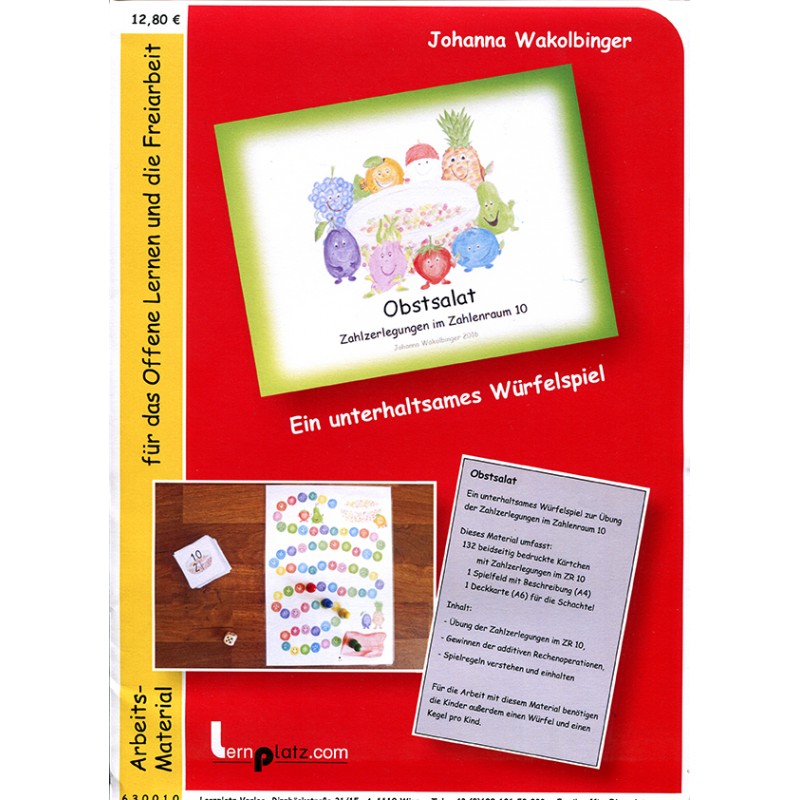

A fun dice game for practicing number decompositions in the number range of 10
Please note:
Montessori materials are NOT toys, but educational materials. Proper use requires appropriate training.
Montessori materials may contain small, rough, sharp, or other elements that could cause injury or damage if used improperly.
It may therefore only be used by children under the supervision of appropriately trained persons and in an appropriate environment.
Brief description: An entertaining dice game to practice number decompositions in the number range 10. Scope
Brief description: An entertaining dice game to practice number decompositions in the number range 10. Scope
This material includes:
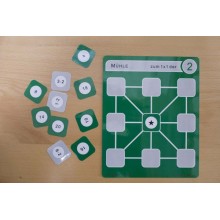
132 double-sided printed cards with number decompositions in the number range 10
1 game board with description (A4)
1 cover card (A6) for the box
Age: Kindergarten, 1st grade. Production: Laminate all sheets (recommended film thickness: 90-125 microns). Then cut out the cards individually. Content / Curriculum reference: Practice of number decompositions in the number range 10, mastering additive operations, understanding and adhering to game rules. Usage possibilities: Mathematics, in small groups (2 - 4 players). Working method
Players take turns rolling the dice. If a child lands on a normal, colorful space, nothing happens, and the next child takes their turn.
If a child lands on a laughing face, they draw the fruit salad card that is on top of the stack.
Example: On the card, there is a number house where 10 is supposed to live, but currently only 2 live there. The child thinks about which number must live next to 2 (8), says this, and is allowed to move forward 8 spaces as a reward – if solved correctly.
If the child lands on a sad face, they solve the next card and must move the corresponding number of spaces backward. In case of a wrong answer, the correct number of spaces is still moved backward.
Then it's the next child's turn.
Self-control The correct solution is on the back of each task card Experiences, tips, notes Before the game starts, certain cards can be selected or sorted out Age Kindergarten, 1st grade Production Laminate all sheets (recommended film thickness: 90-125 microns). Then cut out the cards individually Content / Curriculum reference Practice of number decompositions in the number range 10, mastering additive operations, understanding and adhering to game rules Application possibilities Mathematics, in small groups (2 - 4 players) Working method Self-control The correct solution is on the back of each task card Experiences, tips, notes Before the game starts, certain cards can be selected or sorted out Age Kindergarten, 1st grade Production Laminate all sheets (recommended film thickness: 90-125 microns). Then cut out the cards individually Content / Curriculum reference Practice of number decompositions in the number range 10, mastering additive operations, understanding and adhering to game rules Application possibilities Mathematics, in small groups (2 - 4 players) Working method Self-control The correct solution is on the back of each task card Experiences, tips, notes Before the game starts, certain cards can be selected or sorted out Age Kindergarten, 1st grade Production Laminate all sheets (recommended film thickness: 90-125 microns). Then cut out the cards individually. Content / Curriculum reference: Practice of number decompositions in the number range 10, mastering the additive arithmetic operations, understanding and adhering to game rules. Application possibilities: Mathematics, in small groups (2 – 4 players). Working method: Self-check. The correct solution is on the back of the respective task card. Experiences, tips, notes: Before the game starts, certain cards can be selected or sorted out. Age: Kindergarten, 1st grade. Production: Laminate all sheets (recommended film thickness: 90-125 microns). Then cut out the cards individually. Content / Curriculum reference: Practice of number decompositions in the number range 10, mastering the additive arithmetic operations, understanding and adhering to game rules. Application possibilities: Mathematics, in small groups (2 – 4 players). Working method: Self-check. The correct solution is on the back of the respective task card. Experiences, tips, notes: Before the game starts, certain cards can be selected or sorted out. Age: Kindergarten, 1st grade. Production: Laminate all sheets (recommended film thickness: 90-125 microns). Then cut out the cards individually. Content / Curriculum reference: Practice of number decompositions in the number range 10, mastering the additive arithmetic operations, understanding and adhering to game rules. Application possibilities: Mathematics, in small groups (2 – 4 players). Working method: Self-check. The correct solution is on the back of the respective task card. Experiences, tips, notes: Before the game starts, certain cards can be selected or sorted out. Age: Kindergarten, 1st grade. Production: Laminate all sheets (recommended film thickness: 90-125 microns).Then cut out the cards individually. Content / Curriculum reference: Practice of number decompositions in the number range 10, mastering the additive operations, understanding and adhering to game rules. Application possibilities: Mathematics, in small groups (2 – 4 players). Working method: Self-check. The correct solution is on the back of each task card. Experiences, tips, notes: Before the game starts, certain cards can be selected or sorted out. Age: Kindergarten, 1st grade. Production: Laminate all sheets (recommended film thickness: 90-125 microns). Then cut out the cards individually. Content / Curriculum reference: Practice of number decompositions in the number range 10, mastering the additive operations, understanding and adhering to game rules. Application possibilities: Mathematics, in small groups (2 – 4 players). Working method: Self-check. The correct solution is on the back of each task card. Experiences, tips, notes: Before the game starts, certain cards can be selected or sorted out. Self-check: The correct solution is on the back of each task card. Experiences, tips, notes: Before the game starts, certain cards can be selected or sorted out
A fun dice game for practicing number decompositions in the number range of 10