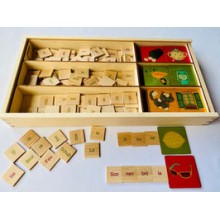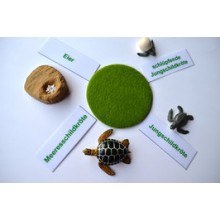

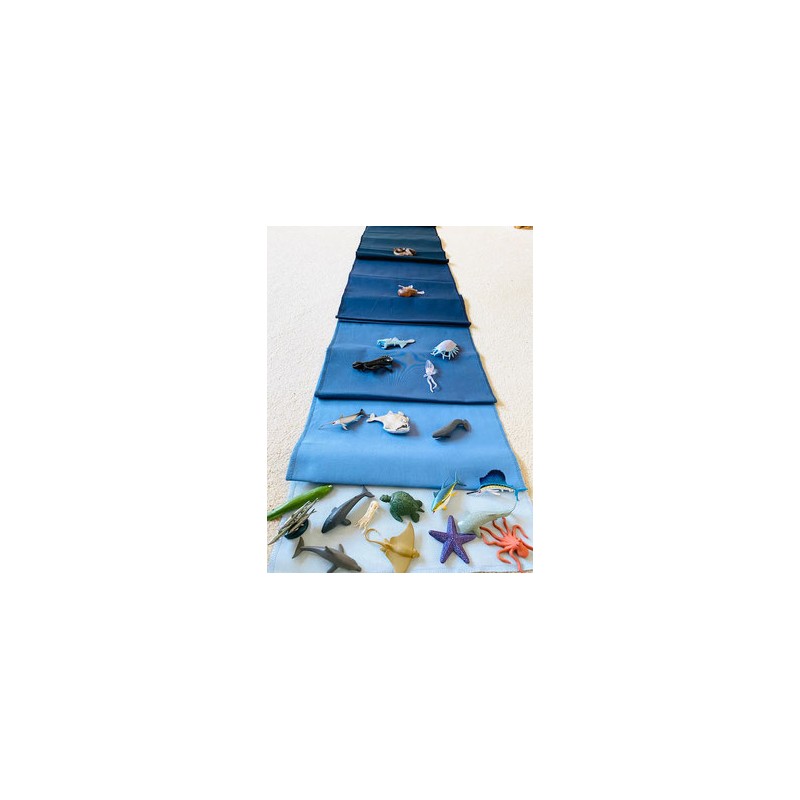

Band in blue tones (5.5 x 0.4m), 22 plastic animals, reading book (33 pages, DIN A4, spiral-bound), research notebook (24 pages, DIN A5), 5 control cards (DIN A5, laminated, spiral-bound), storage box
The band is made of cotton, washable, and is sewn in a non-profit workshop in Germany.
Attention:
Choking hazards, not suitable for children under 3 years!
Please note:
Montessori materials are NOT toys, but educational materials. Proper use requires appropriate training.
Montessori materials may contain small, rough, sharp, or other elements that could cause injury or damage if used improperly.
It may therefore only be used by children under the supervision of appropriately trained persons and in an appropriate environment.
We can observe land animals well; many are familiar to us and well-researched. The children know many animals. We do not know nearly as much about sea creatures. Researchers continually discover new things. Life in the sea is still mysterious. An exciting and fascinating animal world for children.
The oceans are not a uniform habitat. Scientists distinguish five oceans and five depth zones. Different inhabitants live at each depth.
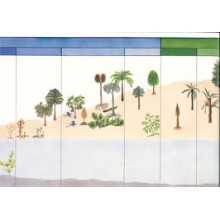
From the water's surface to the deepest parts of the ocean floor, 11,000 meters are measured. Our ocean band is 5.50 meters long, 30 centimeters wide, and colored in different shades of blue corresponding to the depth zones of the oceans proportionally designed. The zones are named and labeled and can be well captured. The seemingly endless depth of the ocean becomes clear. The children get an impression of how deep and dark the sea is.
A comprehensive reading book provides a lot of information, allowing children to independently explore the seas: "- how deep is the sunlight zone, the twilight zone - where does the deep sea begin? - what are the living conditions in the sunlight zone or in the deep sea?"
We provide 22 sea creatures for the volume. The reading book contains many remarkable facts about marine animals: "- what does the animal eat? - or is it eaten? etc."
The animals are named and assigned to the volume.
Band in blue tones (5.5 x 0.4m), 22 plastic animals, reading book (33 pages, DIN A4, spiral-bound), research notebook (24 pages, DIN A5), 5 control cards (DIN A5, laminated, spiral-bound), storage box
The band is made of cotton, washable, and is sewn in a non-profit workshop in Germany.
Attention:
Choking hazards, not suitable for children under 3 years!